 DODS DesignWorks
← Back to Home
Every field below traces back to real published research and a $3,000 project cost. This doesn't replace your ads, referrals, or walk-ins — it activates the trust bias already sitting latent in the room, making each one worth more, quietly, for years.
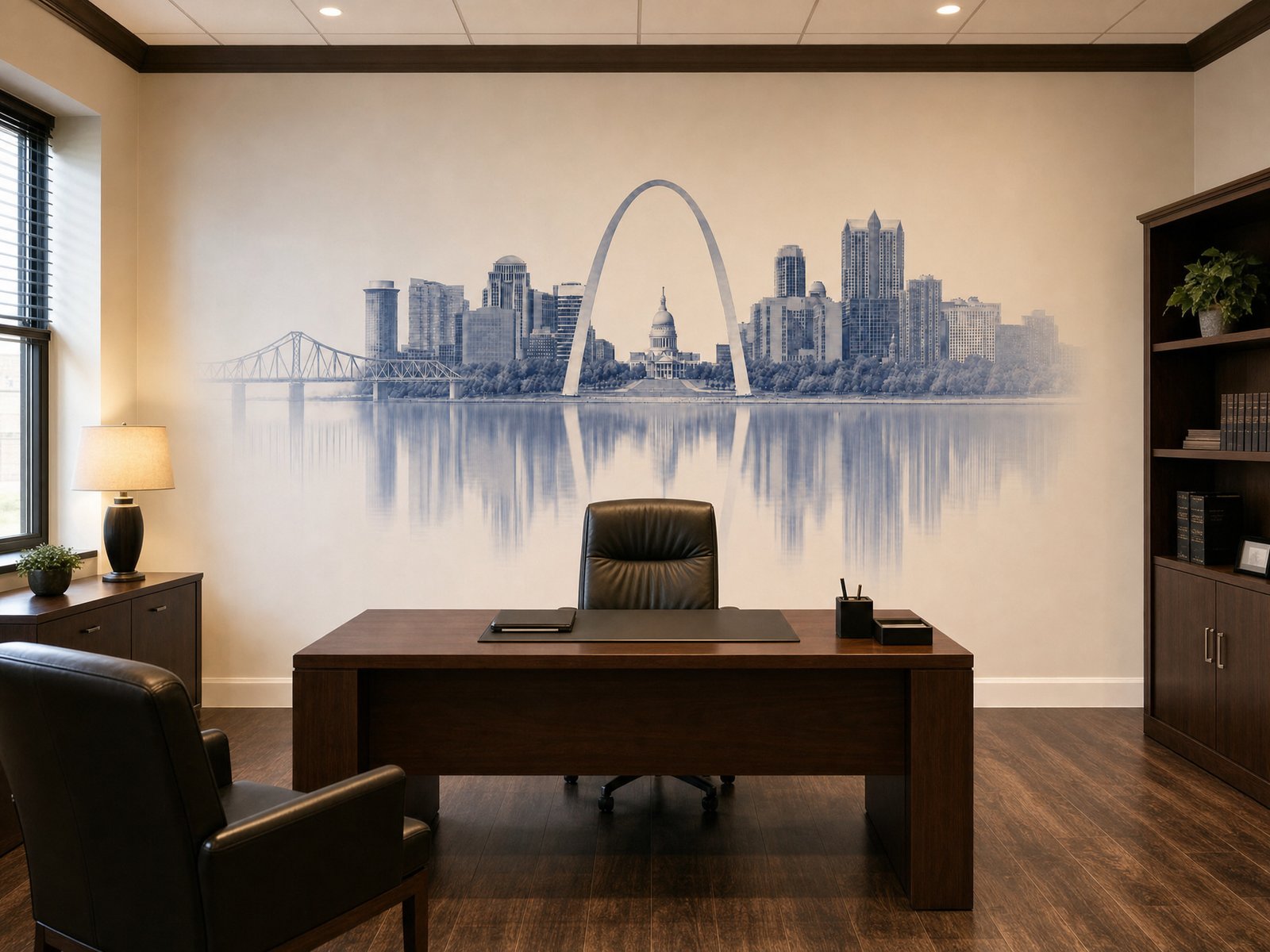
Example office application — the same St. Louis skyline artwork featured in our installation videos.
Nobody leaves a dentist's office and says, "you should see how professional the waiting room felt." That's not a story — it's a compliment, and compliments die in the room they're given.
What gets repeated is: "You have to see this wall. I couldn't believe how the colors popped — I stood there for a minute before I even sat down. Oh, and the doctor was great too."
That sentence is the whole mechanism. The art isn't the sales pitch — it's the reason the actual visit, the actual doctor, the actual service gets told to someone else at all. 88% of people trust a recommendation from someone they know over any ad they'll ever see, and referred customers stick around longer and are worth measurably more over time — one of the most well-established findings in customer-relationship research, not a guess. A wall that's genuinely worth talking about is a low-cost way to manufacture more of the conversations that already convert best.
That's the honest mechanism behind every number on this page: not "the wall directly generates $X," but distinctive spaces get talked about, talked-about businesses get referred more, and referrals are proven to be worth more. Every figure below is a conservative, sourced translation of that chain — never the whole effect, just a small, credible slice of it.
A water feature. Backlit raised letters. Acres of glass and polished metal. That's not distinctive — it's expensive-looking, and expensive-looking reads differently depending on who's paying for it. In a hotel lobby, it says luxury. In a dentist's waiting room, it can quietly say something else: that the money is going into the room instead of the care.
This works differently because it isn't trying to look expensive — it's ink, printed directly into the surface itself. No fixtures, no separate objects bolted to the wall, nothing to maintain. It reads as premium because it's precise and permanent, not because it's ornate. That's the difference between a wall people talk about and a wall that makes them wonder what they're paying for.
Research puts the first-impression window at around seven seconds — before a word is exchanged, formalized in business as "servicescape" theory. For a local business specifically, that impression lands on an already-receptive audience: 67% of consumers say they trust local businesses more than online-only companies.
Sources: Psychology Today; Bitner, "Servicescapes," Journal of Marketing, 1992; consumer local-business trust research.
It doesn't call in sick or have an off day. Every visitor gets the same first impression, whether they're the first person in the door or the last.
This is a design property of the medium, not a projection.
Canvas fades. Vinyl peels and needs re-application every 5–7 years. Printed directly onto the surface, this is a one-time cost — the "cost per year" goes down every year it stays on the wall.
See the per-profession comparison below for the specific replacement-cost math.
Don't see your field? The same math applies — send us your wall and we'll walk through your numbers specifically. We're continuously studying the market and adding new profession-specific cases regularly.
Three faces of the same mechanism: trust bias — a visitor's baseline inclination to trust a clean, memorable, well-oriented space, activated rather than manufactured.